
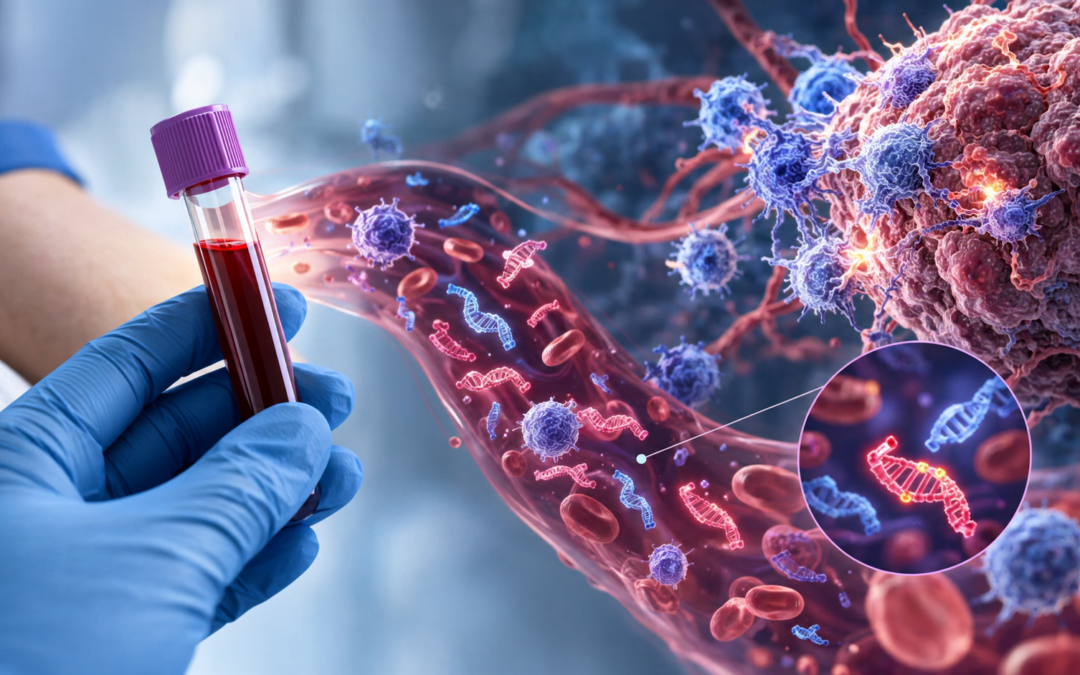
Immunotherapy is now an established treatment option for patients with metastatic lung cancer. However, when a patient starts immunotherapy, everyone anticipates an answer to a single question. Is the treatment effective? This question is typically addressed with a CT scan, often months later, and even then, the result can be ambiguous, as some tumors may initially appear enlarged on a scan due to local inflammation and immune cell recruitment before they begin to shrink in response to treatment. A more accurate and timely assessment of the response is therefore essential. This is exactly what we sought to address in our recent work by investigating whether tumor-derived DNA fragments, known as circulating tumor DNA (ctDNA), assessed through a single, well-timed blood draw could tell us whether a patient’s tumor is responding to immunotherapy.
Using targeted error-correction sequencing of 328 plasma samples and 109 matched white-blood-cell samples from 109 patients with metastatic non–small cell lung cancer (NSCLC) treated with immune checkpoint inhibitors (either alone or in combination with chemotherapy), our team tracked the cellular origin of 2,818 variants while accounting for biological noise arising from clonal hematopoiesis to determine tumor-derived sequence alterations.
Next, we defined landmark molecular response (mR) as undetectable ctDNA at a blood draw within 3 to 9 weeks of starting immunotherapy. How did we select this definition of landmark molecular response? This decision was data-informed; we considered several definitions of molecular response based on single-timepoint ctDNA levels (landmark) or dynamic changes in ctDNA (from baseline to landmark). We also analyzed variation in ctDNA levels within the landmark interval (3-9 weeks). Our results showed that undetectable ctDNA at the landmark timepoint predicts survival on immunotherapy without requiring a matched baseline sample from the patient, thereby circumventing the logistical and financial burden associated with two-timepoint assessment alternatives.
In other words, patients with landmark mR progressed later and lived longer than those who did not attain a mR. Simply put, a ctDNA-negative blood draw in the early on-treatment period (3-9 weeks) effectively separated patients who had durable clinical benefit from those who experienced disease progression.
Liquid biopsy applications in immunotherapy promise to provide clear, timely answers to help optimize treatment, so patients do not receive ineffective drugs or discontinue therapies that may be beneficial. Our findings bring that promise one step closer to clinical translation by enabling a more feasible and robust approach that can provide answers while there is time to change the treatment plan. Future prospective efforts to validate our findings may help pave the way toward establishing landmark ctDNA molecular response as a robust, reliable surrogate of response or resistance to immunotherapy and inform adaptive clinical decision-making.
Click here to read the article in Clinical Cancer Researh.
How this ties to earlier published works from our group
- Readers of our earlier blog post and work on clonal hematopoiesis are familiar with the critical challenge in plasma-only liquid biopsies lacking matched white blood cell samples: Not every mutation we measure in plasma comes from the tumor. Aging blood cells shed their own mutated DNA fragments (clonal hematopoiesis), and these “impostors” can confound the tumor-derived signal we are interested in. In this work, we filtered out this biological noise before determining ctDNA response.
- Our study is directly related to the BR.36 trial, a randomized, ctDNA-directed study, in which molecular response is used to guide treatment intensification in patients with non-small cell lung cancer with detectable ctDNA after 6 weeks of therapy with the immune checkpoint inhibitor, pembrolizumab.