
Precision oncology is increasingly driven by next-generation sequencing (NGS) technologies, advanced techniques that allow for parallel sequencing of millions of nucleic acid fragments. These technologies have enabled comprehensive genomic profiling of tumor tissue and circulating cell-free DNA (cfDNA), the latter facilitating minimally invasive molecular testing in individuals with cancer. cfDNA consists of short DNA fragments released into the bloodstream; a fraction of which originates from dying cancer cells and is referred to as circulating tumor DNA (ctDNA). Despite the promise of liquid biopsies, interpreting their results can be challenging because not all DNA molecules detected in the bloodstream originate from a tumor. One important confounding factor in liquid biopsies is clonal hematopoiesis (CH), an age-related process in which blood cells acquire mutations and expand over time. These blood-derived mutant DNA molecules are released into the bloodstream alongside tumor-derived DNA, making it difficult to determine whether a mutant DNA molecule originated in cancer or non-cancerous blood cells. Given that precision oncology increasingly relies on genomic biomarkers to guide treatment selection and clinical trial enrollment, the accurate classification of mutations detected in liquid biopsies is critical for therapeutic decision-making.
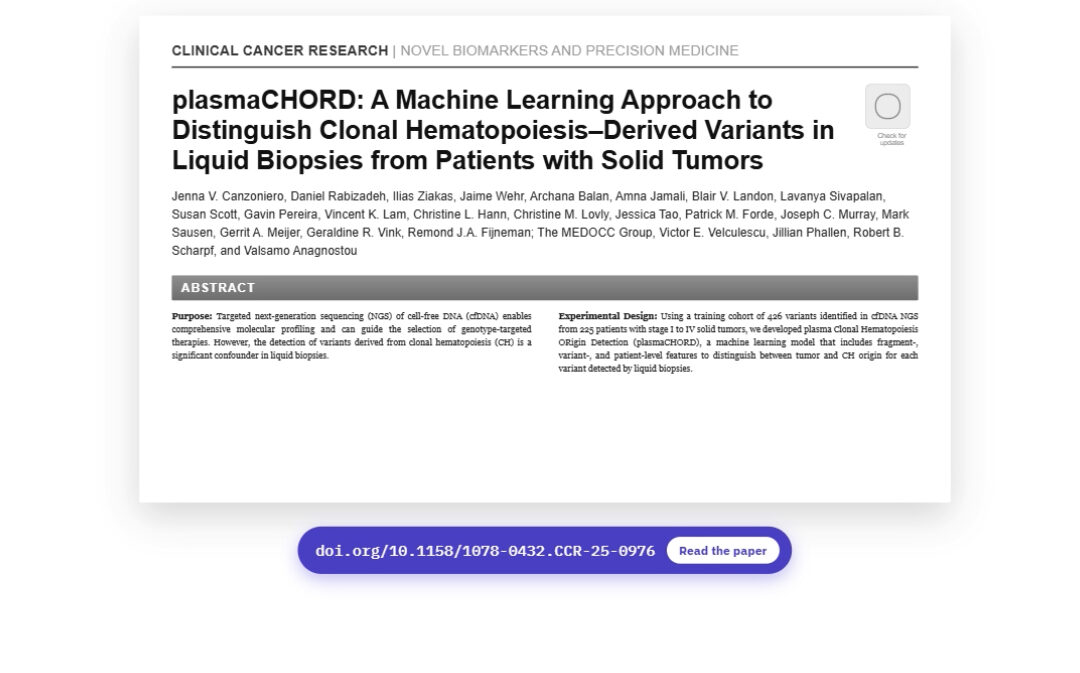
To address these challenges and enhance the accuracy of liquid biopsies, recent work from our Molecular Oncology laboratory introduced plasmaCHORD, a machine learning model that accurately distinguishes tumor-derived mutations from CH mutations in cfDNA. This work was presented at the 2026 American Association for Cancer Research Annual Meeting, was recognized with the AACR-Margaret Foti Foundation Scholar-in-Training Award and was concurrently published in Clinical Cancer Research.
Several approaches can help resolve the true origin of mutations detected in cfDNA. Matched white blood cell (WBC) sequencing can identify variants present in blood cells, allowing these germline and CH-derived variants to be filtered from cfDNA results. Similarly, matched tumor next-generation sequencing can help confirm which plasma variants are truly tumor-derived. However, both approaches require additional sequencing and may be limited by cost, tissue availability, or the feasibility of obtaining tumor tissue in patients with metastatic cancer. plasmaCHORD was developed to address this gap by directly predicting variant origin from plasma NGS data alone.
To train plasmaCHORD, three types of information were integrated: features of the DNA fragments carrying each mutation, features of the mutation and gene itself, and patient-level characteristics. Fragment-level features included DNA fragment length and cleavage-site location, while mutation-level features included variant allele frequency and gene-level context. Patient age was also included because clonal hematopoiesis becomes more common with aging. Using these inputs, plasmaCHORD was trained to classify plasma cfDNA mutations as either tumor-derived or CH-derived. The model was initially trained in patients with both localized and metastatic cancers, and a set of 426 mutations with known origins. It was subsequently validated using an independent dataset of 1,418 mutations of both tumor and CH origin.
Overall, plasmaCHORD demonstrated strong performance in predicting whether plasma cfDNA mutations were tumor-derived or CH-derived. In the independent validation cohort, the model achieved an area under the curve (AUC) of 0.902 and approximately 81% accuracy, indicating that it could reliably distinguish between the two mutation origins. Importantly, plasmaCHORD performed consistently across a diverse range of cancer types, including those not represented in the training cohort. The study also showed that no single feature was sufficient to classify the origin of mutations on its own. Instead, performance depended on integrating multiple sources of information. The most informative features included a measure of how often a gene is mutated in blood-related cancers compared to solid tumors, DNA fragment length metrics, and patient age. plasmaCHORD also performed well in particularly challenging settings, including mutations in commonly mutated cancer driver genes including TP53, where it achieved accuracies of 82.8% and 76.9%, respectively.
To demonstrate plasmaCHORD’s utility in real clinical scenarios, the authors applied the model to two challenging cases reviewed by the Johns Hopkins Molecular Tumor Board. In one patient with metastatic ALK fusion-positive NSCLC, plasma-only liquid biopsy detected an ATM truncating mutation. If tumor-derived, this finding could have raised consideration of DNA repair–targeted therapy; however, the Molecular Tumor Board determined that the mutation was likely CH-derived. In a second patient with NSCLC, liquid biopsy identified an EZH2 truncating mutation that could have indicated potential eligibility for EZH2-directed therapy if tumor-derived. plasmaCHORD classified both variants as CH-derived, matching the Molecular Tumor Board’s interpretation and subsequent confirmation by matched white blood cell sequencing.
Our study highlights that CH-derived mutations are not limited to canonical CH-associated genes. Some suspected CH variants occurred in clinically relevant driver genes and known tumor hotspots, underscoring the limitations of simple gene-based filtering strategies in cfDNA mutation profiling. To this end, plasmaCHORD has the potential to improve the accuracy and clinical utility of plasma comprehensive genomic profiling without requiring matched white blood cell or tumor NGS. Refinement of the plasmaCHORD method and incorporation of additional ctDNA fragment features may further improve performance in a wide range of cancers. Importantly, the model offers an innovative, practical approach for routine liquid biopsy analysis in clinical care. As liquid biopsies become increasingly integrated into cancer care, methods that improve the identification of true tumor-derived mutations may enhance biomarker discovery and support more informed treatment decisions.